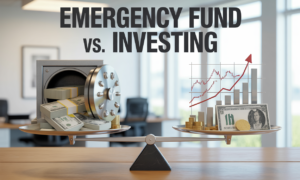
You’re staring at credit card bills and an empty savings account, wondering where to put your next paycheck. The emergency fund vs debt payoff dilemma affects millions of Americans who feel stuck between building financial security and eliminating high-interest debt.
This guide is for anyone juggling debt payments while trying to save money—whether you’re recovering from an emergency expense, starting your financial journey, or debating between the Dave Ramsey approach and other strategies.
Table of Contents
We’ll cover why most experts recommend building emergency savings before aggressive debt payoff, how to manage both goals strategically, and when the debt-first approach might work better for your situation. You’ll also learn how to choose the right debt payoff strategy and transition from debt elimination to long-term wealth building.
Why Building Emergency Savings Should Come Before Aggressive Debt Payoff

How Emergency Funds Protect Your Credit Score from Medical Bills
When unexpected medical expenses arise, having an emergency fund acts as a crucial buffer that prevents these costs from damaging your credit score. Unlike other expenses that can typically be paid with credit cards, many medical bills require immediate cash payments or specific payment arrangements that don’t accept credit card transactions. Without emergency savings, you may be forced to miss payments on existing obligations while trying to manage medical costs, which can quickly impact your credit rating.
Medical emergencies often come with additional complications beyond just the initial treatment costs. You might face extended time off work, reducing your income while expenses mount. Emergency savings provide the liquidity needed to cover both medical bills and essential expenses like rent or mortgage payments during recovery periods, preventing a cascade of missed payments that could devastate your credit score.
Why Suze Orman Recommends 8-12 Months of Emergency Savings First
While many financial advisors suggest starting with a small emergency fund of $1,000 before tackling debt, some experts advocate for building more substantial emergency savings before aggressive debt payoff. The reasoning centres on the unpredictable nature of financial emergencies and the limitations of relying solely on credit for unexpected expenses.
A larger emergency fund provides comprehensive protection against job loss, which is one of the most devastating financial emergencies. Unlike smaller unexpected expenses, unemployment can last for months, requiring substantial savings to maintain housing and transportation while searching for new employment. Credit cards and other debt instruments may not be sufficient to cover mortgage or rent payments, as many lenders don’t accept credit card payments for these essential expenses.
The extended emergency fund approach recognises that credit availability can change without warning. Lenders can reduce credit limits or close accounts based on changed circumstances, leaving you without the backup you thought you had. Having 8-12 months of expenses saved ensures you’re not dependent on credit products that could disappear when you need them most.
How Depleted Emergency Funds Force You Into Higher Interest Debt
Without adequate emergency savings, you enter a destructive cycle where each unexpected expense pushes you deeper into high-interest debt. When your emergency fund is depleted or nonexistent, credit cards become your only option for handling surprise costs, often at interest rates of 25-30% annually. This creates a situation where paying down existing debt becomes increasingly difficult as new emergencies continuously add to your balance.
The psychological impact of depleted emergency funds cannot be understated. When you’ve worked hard to pay down credit card debt only to have an emergency force you back into debt, it becomes incredibly discouraging and can derail your entire debt payoff plan. This cycle – pay down debt, encounter an emergency, add to debt – can repeat indefinitely without proper emergency savings as a buffer.
Consider the practical limitations: your mortgage company won’t accept credit card payments, most rental agreements don’t allow credit card payments, and many auto loans require traditional payment methods. When these essential payments are due, and you have no emergency fund, you may be forced to take cash advances on credit cards at even higher interest rates, or worse, miss payments entirely and damage your credit score. Emergency funds prevent this scenario by providing immediate access to cash when credit cards aren’t accepted or available.
Strategic Debt Management While Building Your Emergency Fund

Using Balance Transfers to Reduce Interest Rates During Recovery
When you’re simultaneously building an emergency fund and managing debt, balance transfers can be a powerful strategic debt management tool to reduce the financial burden of high-interest payments. Debt consolidation through balance transfers allows you to move multiple high-interest debt balances to a new credit card or loan with a lower interest rate, effectively combining those loan balances into one new balance with a single, ideally lower interest rate.
This approach serves multiple purposes in your debt elimination plan. By securing a lower interest rate, you reduce the total amount you’ll pay over time, which frees up cash flow that can be redirected toward building your emergency savings. The simplified payment structure of having just one monthly payment instead of multiple debt obligations also makes it easier to manage your budget while working toward your emergency fund vs debt payoff goals.
However, before consolidating, it’s crucial to review the terms of each of your current loans carefully. Some types of debt, particularly federal student loans, may come with unique benefits that you could lose through consolidation. The key is ensuring that the new consolidated payment is genuinely lower than your current combined payments, allowing you to use the difference to accelerate your emergency fund building.
Why You Should Only Make Minimum Payments While Rebuilding Savings
Now that we’ve covered how to reduce interest rates, it’s important to understand why making only minimum payments on debt during the emergency fund building phase is often the most strategic approach. This strategy directly contradicts the impulse to throw every extra dollar at debt balances, but it serves a critical protective function in your overall financial plan.
When you focus on building your starter emergency fund first—typically $500 to $1,000—making minimum payments ensures you maintain good standing with creditors while prioritising your financial safety net. This approach prevents small emergencies from becoming new debt, which is essential for breaking the cycle of borrowing that keeps many people trapped in debt.
The reasoning is straightforward: without emergency savings, the next unexpected expense will likely go right back on a credit card, erasing your hard work on debt payoff. A surprise $700 car repair becomes a major setback when you have no savings, often forcing you back to high-interest credit cards. With even a small cash fund, that repair becomes simply an inconvenience you can handle without derailing your debt elimination plan.
Once you reach your initial emergency fund goal, you can then shift your strategy and channel all extra money toward your highest-interest debt while maintaining your automated savings contributions.
How to Avoid Raiding Retirement Accounts for Debt Payoff
With this strategic approach in mind, it’s crucial to understand why preserving your retirement accounts should be non-negotiable during your debt recovery journey. While it may seem logical to tap into 401(k) or IRA funds to eliminate debt quickly, this approach can severely damage your long-term financial security and should be avoided as part of any sound debt payoff strategy.
Retirement account withdrawals typically come with significant penalties—often 10% for early withdrawals plus income taxes on the full amount. This means you’re not getting full value from your savings, and you’re essentially paying a premium to access money that’s meant for your future. Additionally, money withdrawn from retirement accounts loses the powerful benefit of compound growth over time, which can cost you tens of thousands of dollars in potential retirement wealth.
Instead of raiding retirement funds, focus on the strategic debt management approaches outlined earlier: building your starter emergency fund through budget optimisation, making minimum debt payments while establishing your safety net, and using tools like balance transfers to reduce interest burdens. These methods protect both your current financial stability and your future retirement security.
If you’re facing truly overwhelming debt that makes minimum payments impossible, explore professional debt settlement options or credit counselling services before touching retirement funds. These alternatives can help restructure your debt obligations while preserving the retirement savings that are critical for your long-term financial well-being.
The Dave Ramsey Approach: Debt First, Then Wealth Building

How the 7 Baby Steps Create a Clear Financial Roadmap
Dave Ramsey’s 7 Baby Steps provide a systematic approach to debt payoff strategy and wealth building that millions have followed to financial freedom. This method creates clear milestones that build momentum through psychological wins while maintaining focus on long-term financial stability.
The debt snowball method forms the foundation of Baby Step 2, where you pay off all debt (except your house) by listing debts from smallest to largest balance,e regardless of interest rate. You make minimum payments on all debts except the smallest, throwing every extra dollar at that smallest debt until it’s eliminated. This approach leverages behavioural psychology over mathematical optimisation, recognising that personal finance is 80% behavior and only 20% head knowledge.
The beauty of this structured approach lies in its simplicity and momentum-building design. Each completed step provides motivation to tackle the next challenge, creating sustainable behaviour change that leads to lasting financial transformation.
Whya $1,0000 Emergency Fund Comes Before a Major Debt Payoff
Before aggressive debt elimination begins, Ramsey’s approach requires establishing a $1,000 starter emergency fund. This strategic decision addresses the reality that unexpected expenses will occur during your debt payoff journey, and without this buffer, you’ll likely accumulate new debt when emergencies arise.
The starter emergency fund serves multiple critical purposes in your debt elimination plan. First, it prevents you from derailing your progress when life happens—whether it’s a car repair, medical bill, or home maintenance issue. Second, it provides psychological security that reduces the anxiety often associated with aggressive debt payoff strategies.
This $1,000 buffer is intentionally modest to maintain your urgency around debt elimination while providing essential protection. It’s not meant to be comfortable—it’s designed to keep you motivated to complete your debt payoff quickly so you can build a fully funded emergency fund of 3-6 months of expenses.
Mathematical Proof That Debt-Free Investing Builds More Wealth
The mathematical advantage of becoming debt-free before major investing becomes clear when examining compound interest working for you rather than against you. When you’re paying interest on debt while trying to invest simultaneously, you’re essentially betting that your investment returns will exceed your debt interest rates—a risky proposition that adds unnecessary complexity to your financial strategy.
Consider this scenario: paying off a $20,000 debt portfolio using the debt snowball method with intense focus versus splitting efforts between minimum debt payments and investing. The debt snowball approach, as demonstrated in Ramsey’s methodology, can eliminate $20,000 in debt in less than 24 months through focused intensity and extra income generation.
Once debt-free, your entire debt payment amount becomes available for wealth building. If you were paying $944 monthly toward debt elimination, that same amount invested in good growth stock mutual funds averaging 10-12% annual returns creates substantial long-term wealth without the stress and complexity of managing debt payments alongside investment strategies.
The psychological benefits compound the mathematical advantages. Debt-free investors sleep better, make clearer financial decisions, and maintain consistency in their investment approach because they’re not worried about debt payments affecting their ability to continue investing during market downturns.
Choosing Your Debt Payoff Strategy Based on Your Situation

When to Use the Debt Snowball Method for Fastest Results
The debt snowball method proves most effective when you need psychological motivation to maintain momentum in your debt elimination plan. This strategy involves paying the minimum amount on all your bills while putting as many dollars as you can toward the smallest debt balance each month. As you eliminate these smaller debts, the money that was allocated to them gets redirected toward the next smallest debt, creating an ever-growing “snowball” effect.
This approach works best for individuals who:
- Need quick wins to stay motivated
- Struggle with maintaining long-term financial discipline
- Have multiple small debts that can be eliminated relatively quickly
- Find the emotional boost from clearing debts outweighs mathematical considerations
The snowball method builds confidence with each paid-off balance, reinforcing financial discipline that leads to long-term success in debt reduction. While critics point out that it doesn’t address high-interest debt immediately and potentially costs more in interest overall, the boost in morale from clearing smaller debts often outweighs this disadvantage for many people.
How to Focus Extra Payments on the Highest Interest Credit Cards
The avalanche method offers a mathematically superior approach by prioritising debts with the highest interest rates first. This debt payoff strategy begins with paying the minimum required on all your bills, but then directs any additional funds toward the debt with the highest interest rate.
To implement this strategy effectively, Organise
- Organize your debts by listing all payment information, total amounts owed, minimum monthly payments, and due dates
- Sort accounts by arranging your list from the highest interest rate to the lowest interest rate
- Budget beyond minimums by determining how much extra you can afford toward your highest interest rate account
- Roll over payments by taking the money previously used for paid-off high-interest debt and applying it to the next-highest interest rate account.
This method effectively reduces the total amount of interest paid over time by minimising the impact of high-interest charges. The long-term savings on interest can be substantial, though it requires patience and perseverance since visible progress might be slower than the snowball method.
Why Credit Card Debt Takes Priority Over Student Loans and Mortgages
Credit card debt typically carries the highest interest rates among common debt types, making it the most expensive debt to maintain long-term. According to the reference content, credit card delinquency rates have risen to 9.1%, demonstrating the financial burden these debts create for consumers.
When prioritising debt payoff strategy decisions, credit cards should come first because:
- Higher interest rates: Credit cards often carry interest rates significantly higher than student loans or mortgages
- Compounding effect: High-interest debt compounds rapidly, increasing your overall payoff amount and extending repayment time
- Financial flexibility: Eliminating credit card debt frees up monthly cash flow faster than longer-term, lower-interest debts
Student loans and mortgages, while still debts requiring attention, typically offer lower interest rates and may provide tax advantages that credit cards don’t offer. The avalanche method specifically targets these high-interest debts first, ensuring you save money by not letting interest accumulate on the most expensive balances.
Strategic debt management requires focusing extra payments on credit card balances while maintaining minimum payments on lower-interest debts like student loans and mortgages, maximising your financial efficiency and minimising long-term costs.
Building Long-Term Wealth After Eliminating Debt

How to Invest 15% of Income Once Debt-Free
Now that you’ve eliminated debt, the money previously going toward creditors becomes your most powerful wealth-building tool. The transition from debt payments to wealth building represents a profound psychological shift from a mindset of scarcity and obligation to one of abundance and opportunity.
Start by redirecting your former debt payments into retirement accounts. If you have access to an employer retirement account like a 401(k), begin there to maximise any employer matching benefits. Once you’ve secured the full match, expand your contributions to reach the 15% target. Consider supplementing with an Individual Retirement Account (IRA) if needed to hit your percentage goal.
The key is consistency in your investing approach. Just as it was thrilling to watch debt balances shrink, watching your retirement savings grow can be even more exciting. Automate your contributions to remove the temptation to spend this money elsewhere, maintaining the disciplined habits you developed during debt payoff.
Why Consistent 401k Contributions Create Millionaire Status
Previously, your financial energy was focused on paying for the past – now you get to invest in your future. The power of compound interest becomes your greatest ally when you consistently contribute to retirement accounts over time.
By consistently investing the money that was once trapped in debt payments, you allow compound interest to work its magic. Each dollar invested today has decades to grow, and the earlier you start this consistent pattern after becoming debt-free, the more dramatic your wealth accumulation becomes.
The mathematical advantage is clear: money that compounds over 20-30 years creates exponentially more wealth than sporadic or delayed contributions. Your disciplined debt payoff approach has already proven you can stick to a financial plan – apply that same consistency to building wealth, and millionaire status becomes an achievable goal rather than a distant dream.
How Debt-Free Income Accelerates All Financial Goals
With debt elimination behind you, every financial goal becomes more attainable. The cash flow previously consumed by interest payments now flows directly toward your priorities, creating unprecedented acceleration in wealth building.
This liberation extends beyond retirement savings. You can now establish dedicated funds for major life goals – whether saving for a down payment on a new home, creating a “dream fund” for travel or education, or building generational wealth for your children’s future. The same monthly amount that once serviced debt can be strategically allocated across multiple financial objectives.
The momentum you’ve built through debt payoff translates seamlessly into wealth accumulation. Your proven ability to manage money, stick to budgets, and prioritise long-term goals over immediate gratification becomes the foundation for accelerated progress on all fronts. Without the burden of debt payments, you have the freedom and resources to design a future defined not by financial obligations, but by your own dreams and aspirations.

The path between emergency funds and debt payoff isn’t one-size-fits-all, but the evidence points toward building a foundation of security before aggressive debt elimination. Whether you follow Suze Orman’s approach of prioritising 8-12 months of emergency savings or Dave Ramsey’s Baby Steps method of tackling debt after a $1,000 starter fund, the key is choosing a strategy that matches your risk tolerance and financial situation. Remember that high-interest credit card debt requires immediate attention, while “good debt” like mortgages and student loans can often wait as you build your safety net.
Your income is your greatest wealth-building tool, and every dollar going toward past mistakes can’t work toward your future goals. Start with a realistic emergency fund that prevents you from falling deeper into debt, then systematically eliminate high-interest balances using proven methods like the debt snowball. Once you’re debt-free with a fully funded emergency fund, you’ll have the freedom to invest 15% of your income toward retirement and build long-term wealth. The sooner you break free from debt payments, the faster you can start building the financial future you deserve.